
Where Magna Past Residents Appear
A house-history search moves backward through sources with different coverage. The Recorder gives recorded parties and document references. Polk volumes can show a dated householder or street entry. The Utah State Archives death index and FamilySearch collections can supply historical people records. Sanborn maps and county GIS explain changes in buildings and parcels. Magna’s Cityworks route may hold address-specific permits and certificates, although the external fields were not fully inspected.
| Source | Years It Covers | Where Held | What It Shows |
|---|---|---|---|
| Recorder index | Online to 1941; older vault digitization toward 1850 | Salt Lake County Recorder | Recorded parties and instruments |
| Polk city directories | 1928–1980-era Magna/suburb coverage | Marriott Digital Library | Dated names, streets, firms, groups |
| Death index and archives | Historical slices; collection-dependent | Utah State Archives | Death-index fields and copy path |
| Maps and GIS | 1931, 1952, current and historic imagery | LOC, USGS, county viewer | Buildings, roads, parcels, context |
| Permits and certificates | Current portal route; fields vary | MSD / Cityworks | Address work and inspection history |
Start with the current parcel when the address is known, and start with a directory or archive when the person or era is known. The source set does not provide a sampled private Magna owner or a transcribed historical household entry, so the method stays evidence-led.
The Utah State Archives death index offers a dated historical path when a past resident’s death record is the next lead.
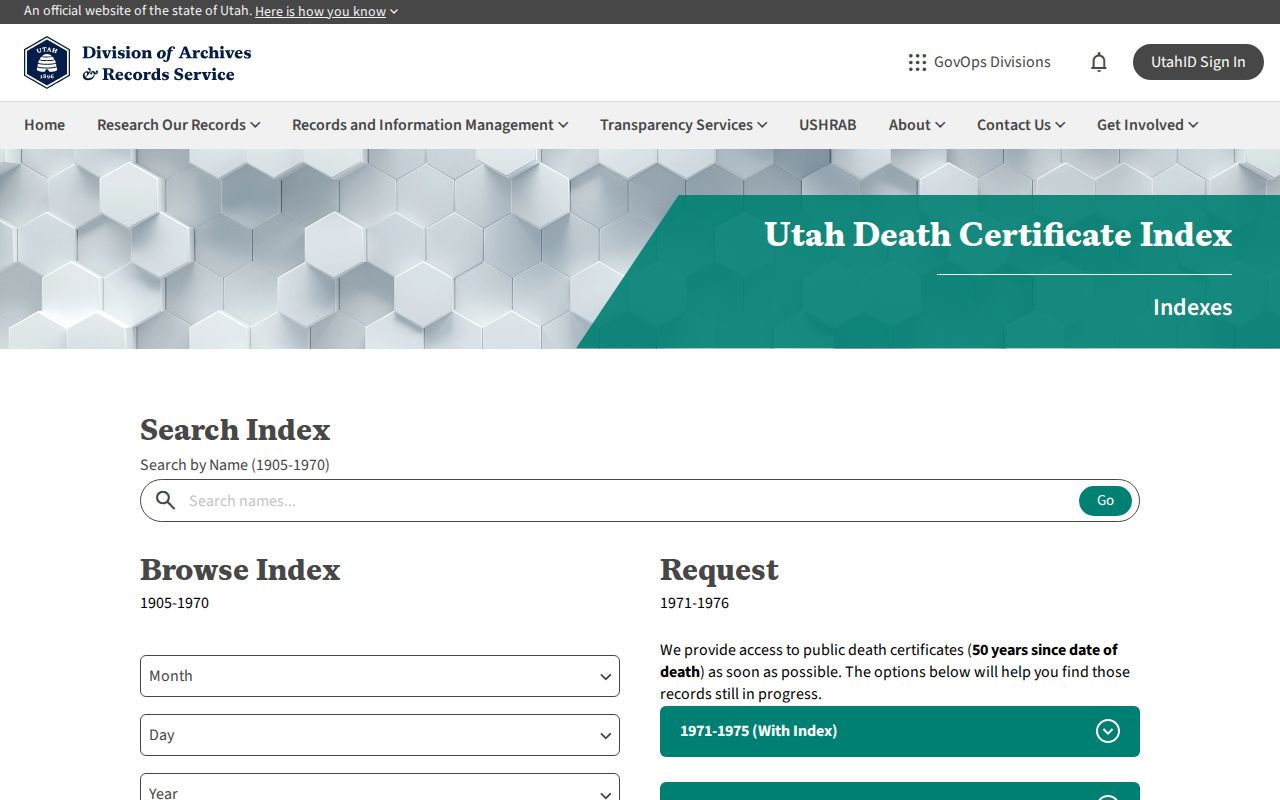
The index is a historical record route, and a copy request remains separate from locating an index entry.
Maps That Date a Magna Address
The Library of Congress Sanborn item describes a 1931 Magna set of five sheets. It provides fire-insurance map context for streets, building footprints, and businesses. A 1952 USGS topographic map adds an older road and landform view. Current county Parcel Viewer imagery, including 2012–2014 historic imagery, can then bridge toward present parcel geography.
Use maps to ask why an old address does not match a current parcel number. They can show a moved structure, changed street context, or business footprint, but they do not name every household. The 1931 Magna Sanborn map item is public-domain context for a dated address story.
Compare the map date with the directory date before treating a location as continuous. A 1931 footprint can explain where a store or residence sat at that moment, while a 1952 topographic sheet may clarify roads and open land rather than occupants. The county imagery is likewise a time slice. Record the source, year, sheet or parcel, and the question it can actually answer.
Walking Back a Magna Deed Chain
Begin with the current parcel from the Salt Lake County Assessor. Confirm the location in Parcel Viewer, then search the Recorder for the latest deed or conveyance. Follow the grantee, the person receiving an instrument, backward to the earlier grantor, the person conveying it. The legal description, rather than a changing street label, is often the steadier key in older records.
- Save the current Assessor owner, property location, parcel, and legal-description fields.
- Search the Recorder public index with the parcel or address and identify the newest relevant instrument.
- Read the grantor and grantee names, recording date, book/page or entry, and document type.
- Search the earlier grantee as a later grantor, repeating the chain while the parcel description remains consistent.
- For records older than the online reach, ask the Recorder about vault, in-person, digitized, or copy-request options.
A deed chain is strongest when several identifiers agree. Keep the parcel number, legal description, recording date, instrument type, grantor, grantee, and image or entry reference together in your notes. A name-only match can join two unrelated people, especially when a surname is common or an instrument uses initials. If a transfer appears to skip a period, mark the gap and ask the Recorder about the next appropriate index or document request rather than filling it with an assumption.
- Grantor / grantee
- The grantor gives or conveys an interest; the grantee receives it.
- Chain of title
- The linked sequence of recorded transfers connected to one property.
- Legal description
- The formal land description in an instrument, often more stable than an old street address.
How Far the Recorder Search Reaches
Salt Lake County says the current online index reaches Book 262, Page 1, Entry 899028, recorded March 1, 1941. A digitization project is working backward toward the 1850 vault. Permanent grantor and grantee indexes, property abstracts and indexes, plats, judgments, and certain water and military-discharge records appear in the retention schedule. Military discharges are restricted and should not be treated as ordinary open name records.
The free search locates an index entry. Data services charge by unit, while document requests charge for ordinary pages, historical or vault pages, ownership or description printouts, and certification as listed by the Recorder. Documents recorded before 2:00 p.m. are typically available the next working day, but plats may take longer. Keep “found in index” separate from “image reviewed.”
The Recorder document-request page describes the partial clues and delivery choices used when an image or certified copy is needed.
Older entries may require more care than a modern parcel search. The online index’s 1941 boundary is a coverage clue, not a claim that no earlier Magna record exists. Search the available name and property fields first, then preserve the exact result and contact the Recorder for the appropriate older index, vault, or copy path. A certified document can answer a legal-description question that a search-result screen cannot.
Magna’s Local Clues for House History
The official history gives useful search vocabulary: Pleasant Green, Ragtown, Greektown, Japantown, Snaketown, Little Italy, Utah Copper Company, Magna Mill, Boston Consolidated, and Arthur Mill. Ragtown was temporary and homes were moved, so an address change may reflect a structure move rather than a family leaving. Treat that as a research question until a deed, map, newspaper, or directory confirms it.
The ca. 1930 Mss C 949 commercial tax photographs name J.C. Penney, White Lily Bakery, New Palace Hotel/Pool/Beer Hall, Mort Market, and the Women’s Club/Public Library among other storefronts. Those public business names can anchor a safe historical address story without selecting a modern private owner.
Past Magna Households in Directories
Owners are only part of the previous residents story. Polk volumes include alphabetical, householders or street-guide, and classified sections. The householders classification is a dated directory label, not proof of ownership or present occupancy. Pair a street entry with the volume’s year and spatial description, then use the Magna city directory collections page for the collection details.
To close a family trail, use the Utah State Archives death index, FamilySearch probate catalog, newspapers through Salt Lake County Library, and a specific Pleasant Green Cemetery inquiry. A death, obituary, or probate record can identify a person’s life event without proving that the person died at the address being studied.
For a cemetery or obituary lead, send the narrowest question possible: the name, approximate dates, and the Magna connection you are testing. Pleasant Green Cemetery does not provide a public searchable grave database, so an inquiry is a lead rather than an instant confirmation. Cross-check any result against the directory year, a deed or probate record, and the historical neighborhood vocabulary before writing a conclusion about a previous household.
Lawful use. Magna previous-resident research is for house history, family history, and personal curiosity. Never use a past address or living person’s record to stalk, harass, track, intimidate, or harm anyone.